1st Gen Glock 19 - The most common question new Glock buyers are asked is, "What gene is my Glock?" Before the 4th generation, Glock did not officially recognize only the model number, which created the perception that "A Glock is a Glock is a Glock - They are all the same." But early collectors noticed the difference and informally classified it based on three main iterations, or "periods." The nomenclature became popular since Glock released the Gen 4 in 2008, the brochure highlights the previous Gens in several places.
The images below will help you determine the generation of your Glock, but keep in mind that there is a lot of overlap as the models are slowly transitioning. Also, because of California's gun ban, gen 3 guns are still being produced, so you can get a gen 5 gun that is older than a gen 3! Notes in the figure identify key features that are consistent between generations, but small changes in markers and internals are found at different intervals, sometimes back and forth, in the same gene. revision of the main frame, many parts can be swapped between two or more, but some changes are only for a short period of one generation.
1st Gen Glock 19
Period 1 is a period of constant change. While the original design is reliable, it is still under development. One consistent feature is the grip construction that wraps around the handlebars (no front or back straps are checked). It is smoother than the later ones and is considered by collectors to have a "pebble texture". The early gun has a slimmer, stainless steel barrel with a parkerized finish (no more than the prefix AD) and the increased thickness of the barrel wall does not exceed the prefix AN. There are several variants of magazines, cartridges and small internal parts. All guns will have an Austrian proof mark but not fixed location or mark number. Early guns (pre-US) and those intended for the European market do not have serial numbers on the frame. Most early rifles were equipped with target sights known as "Weak Side Sights" because of their fragility. The standard (fixed) sight is also time correct, but the target version will fetch a higher price. At the bottom of the front strap, all frames except 19 have a half-moon well relief.
Glock Reliability And Reputation
Gen 2 is referred to as "Gen 1" by many new collectors and even uninformed dealers. The confusion stems from two factors: 1. Generation 1 is so rare that many casual observers have never seen it. 2. Many models were introduced in the 2nd generation series, some consider it "first generation" because it was the first issue of the model. For convenience, if you have a Model 20 or older, you have a Gen 2 Glock, even if it is the original version of the gun. For the 17-19 model, the main difference between 1 and 2 is the addition of checkers on the front and back straps, and changes in the structure of the side panels (deeper than in generation 1). Generation 2 also introduced an additional 5-gauge, and all non-.380/9mm rifles were fitted with a second locking block pin to prevent the frame from cracking due to heavier recoil. It is important to note that the badge number does not indicate the origin, as many believe. 9mm frames only have two pins for Gen 1 through Gen 3, while all other calibers have 3 pins. All full size frames sit in a mag well below the front strap.
By the end of the 90s, Glock was the dominant force in the American gun market, and other manufacturers were scrambling to copy the model. This led to pressure to "revamp" the Glock design. Gen 3 changes began in 1995 with the introduction of a smaller model. The grip was considered too small to hold, so a finger groove was added to the front strap to increase purchase. rotation caused by recoil. This was followed by a 3-year transition period until 1998, when all models were completely redesigned. Some of the larger transitional models are rare (especially ported versions) - see https:///transitional/ for more info. The Gen 3 will have a finger groove on the front strap, a thumb rest on top of the grip, and additional rails molded into the dust cover. As mentioned above ONLY in 9mm caliber will you find the early 3rd generation 2 pin models. This frame was updated to all 3 pins in the early 2000s.
When the 4th generation came out, Glock was already a "pistol", but faced competitors with more innovative designs. One fashion that caught the attention of consumers was the interchangeable back strap that better accommodates different hand sizes. Glock first tried precision grips on the Gen 3 SF model (they were only available in .45 and 10mm calibers). The modular backstrap system brings SF proportions to the entire frame with two zoom options and even a beavertail adapter insert. The internals were redesigned from the ground up, designed with the .40S & W recoil profile in mind, then chambered for 9mm (reversed from the 1st-3rd generation). It should continue the legendary reliability of the 9 while also proving to make the .40 model even more durable. The grip construction has also been changed to a more aggressive design on the side plate - this was briefly tested on the latest 3rd generation rifle with "RTF2" construction. RTF2s are technically Gen 3, possibly Gen 3.5, and were only produced from 2009-2011 (except special editions) - see image at the bottom of this page.
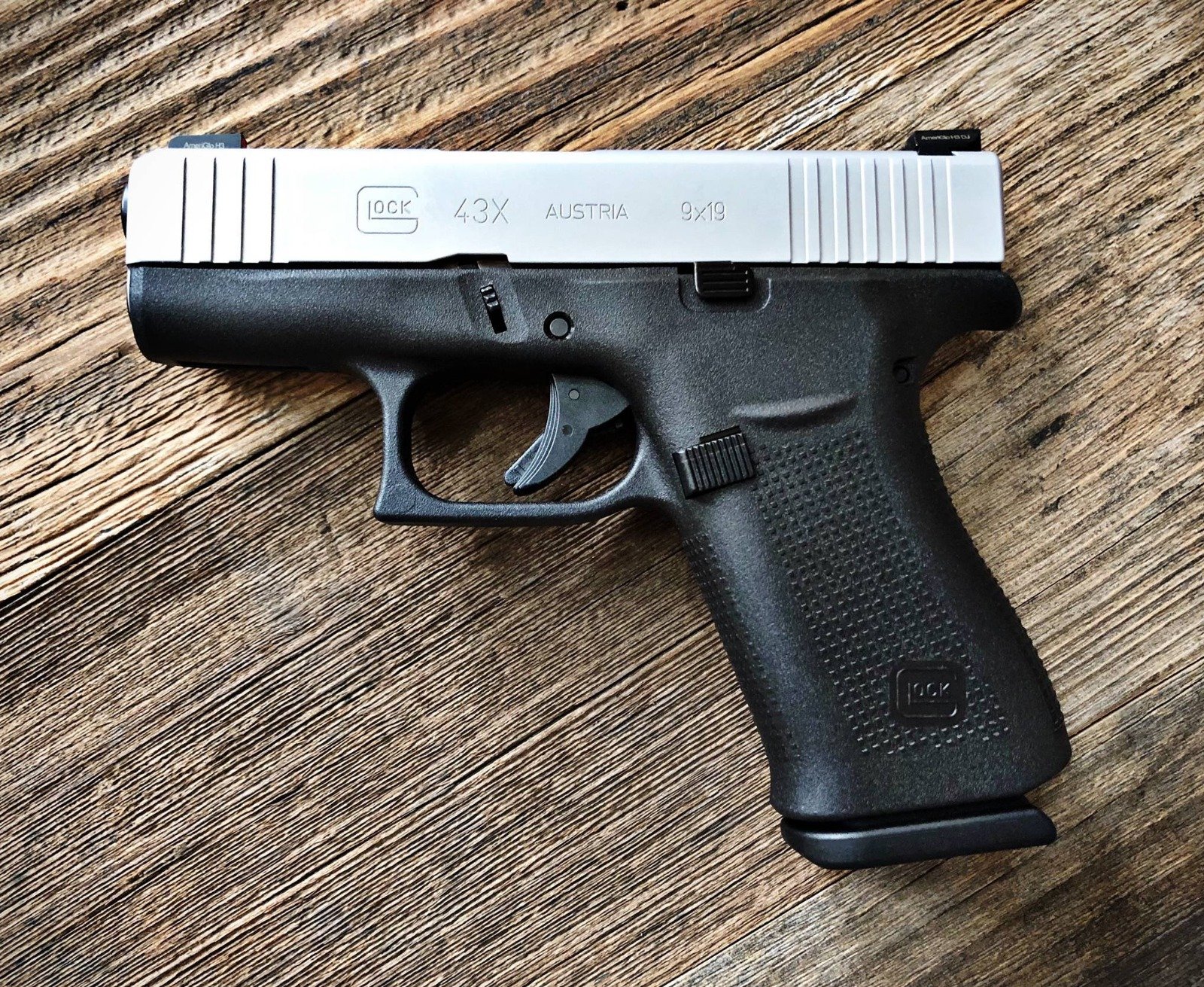
The first 5th generation model came out before the smaller 42 and 43 models. The model started with a redesigned design with all new internal components to fit the smaller size, and the FBI was instrumental in the change. ask for the M model for the big gun. Technically, the 19X, 42, 43, 43X, 44, 45, and 48 don't have the 5th generation markings on the slide, but they fit most other 5th generation guns. 17 and 19 were officially released as Gen 5 in 2017, followed by other 9mm and .40 S & W offerings, but no .357 Sig, 10mm or .45 ACP offerings yet. Major changes of note include a "notice" barrel, fully ambidextrous controls, flared magwell, and removal of the front strap notch.
Glock 19 Gen 4 Vs Gen 5
There are two other models (most) that are practically disconnected from the generation gap or hard to distinguish from the discussion above: 1. RTF2 Third Gens & 2. FBI M-series.
RTF2 stands for "rough texture framework, second version". The first version was only made as a prototype, and at least one was on display at the Cody Firearms Museum, but was never released for sale. The designer landed on the second version, and re-printed the structure of this handle to make it standard in the 3rd generation. All internal parts are the same, so the only difference will be the structure of the handle. As you can see from the exploded view, all the handles are covered in a little pyramid and let me tell you, they are clear! Even when wet, this gun sticks to your hand. Glock sold this mostly to the police between 2009 and 2011, but the design is clearly a step between the third and fourth generation guns. The pyramid concept is continued, but RTF2 has a larger pyramid as it has been damaged and destroyed. See more images at https:///rtf2g/.
Finally, we have to talk about the FBI's M Series pistol. The 17M & 19M preceded and probably inspired the 5th generation rifle. It was developed as a new technical service weapon required by the FBI and incorporated some design changes and some new ideas from the 42/43 mini model. These were the first Glocks with ambidextrous controls and modifications were made to improve the rifle's accuracy. On the outside, the M rifle looks exactly the same as the Gen 5, with a major difference on the inside, so most collectors consider it part of the Gen 5 family. requested.
Glock 19 gen 4 disassembly, glock 19 gen 2 holster, review glock 19 gen 4, glock 19 gen 4 cleaning, glock 19 gen 4 photos, glock 19 gen 3 holster, glock 19 gen 3 price, gen 19 glock, 1st gen glock, glock 19 gen 4 holsters, glock 19 gen 3 disassembly, 1st gen glock 17