A6 Aircraft - The Grumman A2F (A-6) Intruder was the result of a February 1957 Navy request to replace the Douglas ED Skyraider for the Navy and Marines. The application was accompanied by the Type 149, which called for a two-seat aircraft capable of operating in all weather conditions. The ability to take off and land at short distances, as well as a top speed of at least 500 knots and a mission area of at least 300 nautical miles were required. The type specification did not specify how many engines would be used, or even the engine model. Models with the possibility of jet or turboprop engines will be acceptable.
Eight aircraft manufacturers (Boeing, Douglas, Bell, Lockheed, North American, Vought, Martin, and Grumman) submitted their proposals before August 17, 1957.
A6 Aircraft

During the design process, Grumman considered several different configurations, including a straight-winged aircraft with turboprops, twin fins and rudders, as well as a single-engined aircraft with turbojets mounted on M-shaped underbody pods. the internal ones were moved together. And the outer panels were deleted. The design they finally settled on (known by the company as Design 128Q) was a two-seat airplane.
Amazon.com: Hobby Boss A 6a Intruder Model Kit
Since higher performance was not required, the aircraft was powered by a pair of Pratt & Whitney J52 flameless turbojets, mounted in the lower corners of the center section of the fuselage, which were forward on the lower sides of the fuselage. filled with great consumption. Since the aircraft was so small, complex intake geometry was unnecessary, and the inlets were simple D-shaped inlets with a small fixed divider plate to separate the air from the fuselage boundary layer. An unusual feature was the use of a set of extended jet exhaust pipes that could be lowered by 23 degrees to improve STOL performance. A pair of speed brakes were mounted under the rear fuselage, just behind the engine exhaust.
The middle part of the large wing of the face was closed with a medium sweep (25 threads in a quarter thread). The wing had trailing curves that extended almost the entire length of the wing, so conventional ailerons were not installed. Lateral control was accomplished at low speed by the movement of flaps (which act as "flappers") and at high speed by a series of ailerons mounted on the upper surface of the wing. The airfoils can be operated in different ways to control the roll in the aircraft. The wing can be hinged to about 1/3 of the wingspan to keep it in flight. Mess loads were carried on external piles, two under the inner wing panel and one under the centerline of the fuselage.
The main parts of the landing gear were attached to the rear wing spar, on the outside of the fuselage. The members moved forward and rotated 90 degrees so that the wheels were lying on the leading edge of the wing. The landing gear returned to the well below the cockpit.
The horizontal stabilizer was of the aircraft type, with two sets of gears to define the control authority. During flight, stabilizer travel is limited so as not to overload the aircraft, but can be retracted in an emergency, such as a spin.
Grumman A 6e Intruder Arrives At Hickory Aviation Museum
Two crew members sat in ejection seats (the pilot was a few inches in front of the navigator/bombardier) under a bulbous canopy that retracted as the entry and exit unit. There were steps down the side of the plane for the crew to get in and out. A large radar was installed in the nose of the plane. The offensive load was placed completely outboard, suspended under the wing pylons. The artillery was not expected.
Perhaps the most advanced feature of Grumman's design was the use of a new electronic weather system called the Digital Navigational Integrated Attack Equipment (DIANE). This advanced system was based on a pair of antennas on a large radome, one for the Norden AN/APQ-92 search radar, and the other for the Naval Avionics AN/APQ-112 surveillance radar. Also AN/ASN-31 Intel Navigation System, CP-729A Air Data Computer, AN/APQ-61 Litton Ballistic Computer, AN/AVA-1 Vertical Display, AN/APN-1 Radar Altimeter. 141, AN/ASQ-57 Electronic Control System and AN/APN-153 Doppler Navigation System. An Automatic Direction Finder (ADF) was also added, along with Tactical Air Navigation (TACAN) and Identification Friend or Foe (IFF) systems.
Boeing, Douglas, Vought and Martin each presented two designs, a turbojet and a turboprop. Bell, Lockheed, and North American produced only one model each. Bell's design was STOL, and was quickly rejected. Turboprops and single engines were abandoned at an early stage, leaving Douglas, Vought and Grumman as the final three. On January 2, 1958, the Navy announced that Grumman's 128Q was the winner of the design competition.
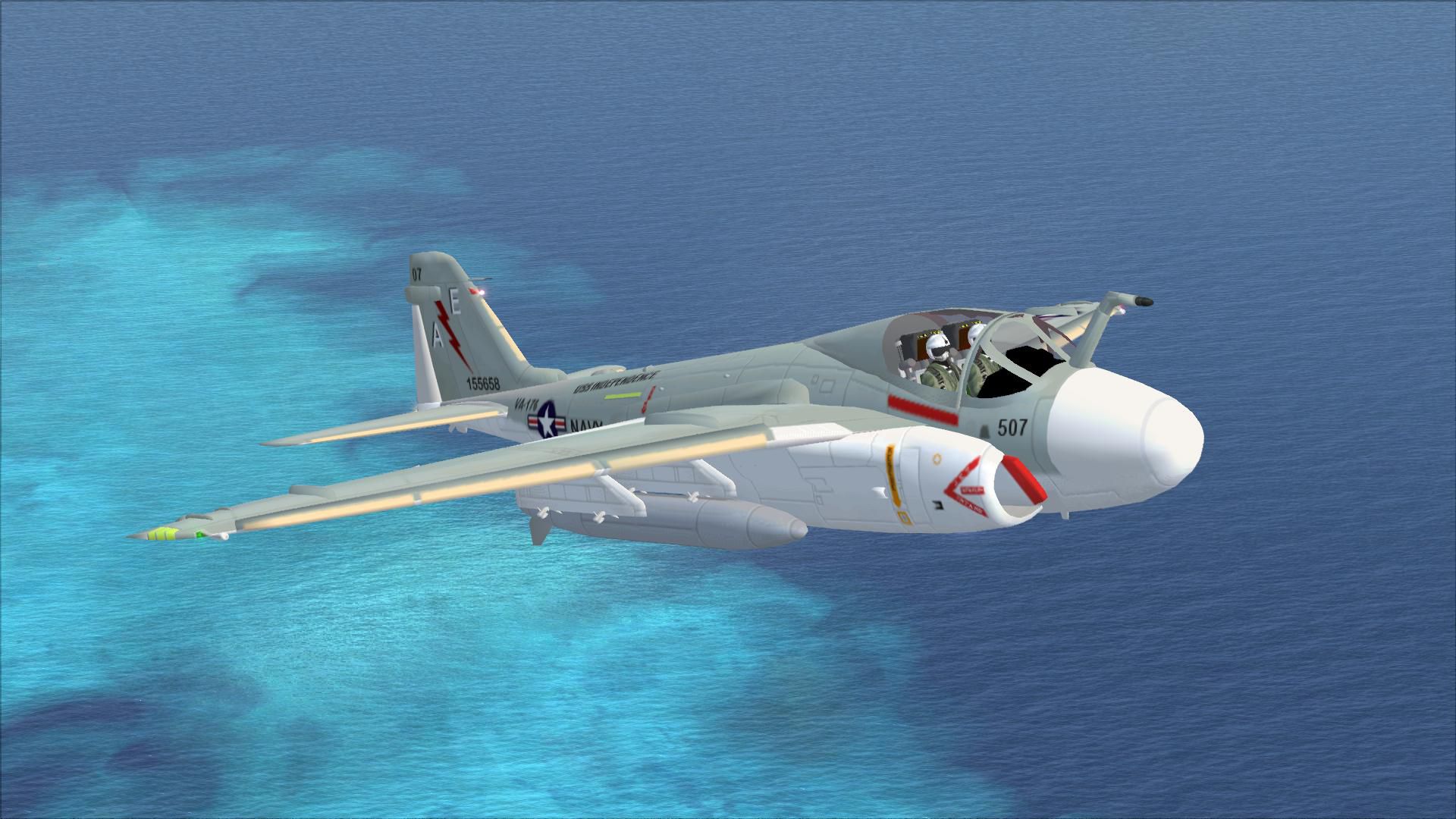
A preliminary design agreement was signed on 21 February 1958, which included preliminary design work and complete mock-ups. In September 1958 the mock-up was reviewed and several changes were suggested. These include straightening the trailing edge of the wing and increasing the wingspan by two feet. The modified single-spaced boards were replaced by the original proposed double-spaced boards. The nose was extended to accommodate the search and tracking radar antennas under the radome. The top was modified to reduce drag. The wings were extended and moved to the rear. A nosewheel catapult system was adopted. Internal fuel capacity increased to 155 gallons.
Hobbyboss 1/48 A6 Intruder Excellently Built And Painted, Hobbies & Toys, Toys & Games On Carousell
If you want to know what happened to this plane and its use in many wars, be sure to listen to this podcast by Danny Caron at Casus Belli. The Grumman A-6 Intruder was a twin-engine mid-wing aircraft designed by the American company Grumman Aerospace. It was in service from 1963 to 1997. The Intruder was designed as an all-weather aircraft that replaced the A-1 Skyraider. Aside from some initial problems with its sophisticated navigation and attack systems, the A-6 quickly proved to be an excellent all-weather attack platform. The ability to carry a large amount of ammunition; The raider will be known as the "Mini B-52". Its attack radar allowed it to excel in bombing missions. It was often used to guide other disabled aircraft in bombing missions, providing navigational information and dropping bombs.
A version of the A-6, the electronic warfare specialist, the EA-6B Prowler, remained in service until May 2008. As the A-6 neared retirement, its precision strike mission was taken over by the now-retired Fg. -14 Tomcat has a LANTIRN, which is later carried by the F/A-18E Super Hornet.
The Intruder attack aircraft was designed according to US Navy specifications to serve as a replacement for the A-1 Skyraider as an all-weather attack aircraft. Grumman was awarded the contract in 1957 and the prototype, designated A2F-1, flew for the first time on April 19, 1960.
In March 1959, a Langley and Grumman team, led by researcher Charles E. Mercer, conducted tests in Langley's transonic tunnel to determine the best speed brake configuration for the A-6. The air brake panels were located immediately behind the engine cooling nozzles at the rear of the fuselage, which caused concerns about the low power and thermal environment of the air brakes in difficult conditions. To further complicate the engineering project, the noses of the original aircraft were also shortened to increase lift at low speeds and reduce approach speed.
Lawrence Mead Jr., Aerospace Engineer Who Helped Design A 6 Bomber, Dies At 94
Various proposed configurations were tested, including changes to the panel layout, which were later incorporated into the A-6A and EA-6A versions. Later A-6 variants used symmetrical split-split ailerons as wingtip speed brakes. The original air brakes were disabled or removed.
An early evaluation of the A-6's turning characteristics and spin recovery, conducted by Henry E. Lee in a vertical wind tunnel, showed that spin recovery could be significantly improved by lengthening the rudder and adding a deflector.
A6 msrp, a6 aircraft registration, dingbats a6, a6 prestige, a6 lease, a6 price, a6 cardstock, a6 cover, used a6, a6 car, a6 envelope, a6 tires