A7 Aircraft - The LTV A-7 Corsair II is a subsonic attack aircraft designed and manufactured by Ling-Temco-Vought (LTV) of America.
The A-7 was developed in the early 1960s as a replacement for the Douglas A-4 Skyhawk. Its design was derived from the Vought F-8 Crusader; Compared to the F-8, the A-7 is smaller and limited to subsonic speeds, with a simpler airframe and easier to manufacture. The first contract for this type was awarded on February 8, 1964, after a competitive proposal by Vought in response to the requirement of the US Navy (USN) VAL (Air-to-Air, Attack, Light). Development was rapid, first flown 26 Sep 1965 and 1 Feb 1967 in USN service; Earlier that year, the A-7 was designed overseas for the Vietnam War.
A7 Aircraft

Originally fielded by the USN, the A-7 became of interest to other services, and was soon adopted by the United States Air Force (USAF) and Air National Guard (ANG) to replace the Douglas A -1 Skyraider and North American F- 100. Super Saber fleet. New versions of the A-7 will be developed, usually with more powerful engines and upgradeable avionics. American A-7s would be used in various major conflicts, including the Battle of Grada, Operation El Dorado Canyon, and the Gulf War. This model was also used to support the development of the Lockheed F-117 Nighthawk.
Vought A7 Corsair Ii Va37 Navy Fighter Aircraft Photo 8x10 Uss Jfk Cv67
The A-7 was exported to Greece in the 1970s and Portugal in the late 1980s. The USAF and USN chose to retire the remaining models of this type in 1991, followed by the ANG in 1993 and the Portuguese Air Force in 1999. The A-7 has been largely replaced by modern fighter jets such as the General Dynamics F-16 Fighting Falcon. Falcon and McDonnell Douglas F/A-18 Hornet. The last user, the Hellenic Air Force, retired the last of its A-7s in 2014.
In the 1960s, US Navy (USN) officials began to consider the need to replace their fleet of Douglas A-4 Skyhawk light attack aircraft.
At the time, it was not clear that the A-4 would continue in production until 1979; Also, according to aviation writers Bill Gunston and Peter Gilchrist, some figures believe that a larger attack platform that can consistently climb to high speeds, carry heavy loads and fly long distances is not necessary. of the past. In defense of the relaunched aircraft is the Secretary of the Navy Robert McNamara, who asked the Navy to consider the problem.
In December 1962, the Sea-Based Air Strike Force (SBASF) training group began detailed work and cost analysis on the subject.
Haf Retired The A 7 Corsair Ii
The team looked at a total of 144 hypothetical flights to support their findings. According to Gunston and Gilchrist, the main result of these studies is that the subsonic aircraft has a higher performance than the supersonic aircraft.
By spreading the difference, the airframe can be made smaller, cheaper, and easier to manufacture; can be purchased from a large part of that loading platform from its independent partner. The speed of development has been increased in relation to subsonic speed, which is better.
Emphasis was placed on direct delivery of weapons, reducing the cost of weapons on target.

On May 17, 1963, these measurements were compiled into a specification known as VAL (Heavier Than Air, Attack, Light).
Airpark With Us Navy A7 Corsair Ii Jet Fighter Airplane Mounted On Display Next To Runway Florida Stock Photo
The Vought concept was based on the F-8 Crusader fighter and shared a similar configuration; However, the airfoil was shorter with a rounded nose that gave the aircraft a "hard" appearance.
These applications were received in September 1963, and the evaluation process was completed in early November of that year.
On February 8, 1964, VAL funding was approved by Congress and the program was likely to continue; three days later, Worth's submission was selected as the winner.
On March 19, 1964, Worth received a contract from the Navy to build the A-7.
Development] A 7d Corsair Ii: Bulk Delivery
In 1965, the A-7 Corsair II was designated; Vought had previously produced three aircraft known as the Corsair. They produced the O2U Corsair biplane scout and patrol aircraft in the 1920s and the SBU Corsair scout bomber in the 1930s. During World War II, the company produced the F4U Corsair. The name Corsair II refers to the famous F4U Corsair, which served as a fighter-bomber in World War II and the Korean War. The aircraft will be built next generation from the same manufacturer and intended for the same attack role.
On November 2, 1965, Vought first demonstrated the first pair of A-7As to 1,000,000 visitors; Test pilot John Conrad demonstrated the aircraft's ability to perform rapid rolls when loaded with six 250 lb (110 kg) and twelve 500 lb (230 kg) bombs. A Navy spokesman confirmed that the A-7 could carry twice the bomb load of an A-4E, or twice the maximum payload of the same payload.
The flight test program continued apace, with no major problems or major delays. According to Gunston and Gilchrist, some Navy officials tried to extend the program so that the A-7's avionics systems could be upgraded for greater capability, but were thwarted by the rush to install it. in the nature of the service.

On October 14, 1966, heavy aircraft were delivered to the Navy for the formation of the first military force.
File:152d Tactical Fighter Squadron A 7k Corsair Ii 73 1008 Refueling.jpg
The first A-7s were operational on 1 February 1967; they were able to begin military operations abroad during the Vietnam War that broke out in December of that year.
A contract was ordered in September 1965 for an additional 140 aircraft. The third contract is for 17 aircraft making a total of 199 A-7A aircraft.
After the first one became operational, a large order was placed for 196 A-7B aircraft equipped with the more powerful Pratt & Whitney TF30-8 engine. Another variant of the type would be ordered for the United States Air Force (USAF) in 1966 as the A-7D.
Based on the gin part, the Allison TF41-A-2, a licensed product of the Rolls-Royce Spey gin, was used by the A-7D.
A6 And A7 Intruder And Corsair Fighting Aircraft Stock Photo
In 1967, the Navy decided to cancel the A-7B order, and 257 aircraft were built.
The prototype of the replacement aircraft, the A-7E, was discovered and produced. This option included some of the USAF's A-7D upgrades, including the TF41 engine and most of the avionics; however, the engine was modified for greater thrust and compatibility with marine systems.
On November 25, 1968, the A-7E made its first flight; 535 planes will be produced.
Several special models were developed in the 1970s and 1980s, such as the TA-7C for training and the EA-7L for electronic warfare.
Scale Military A7 Corsair Ii Attack Plane Usn Alloy Model, Adult Gift And Collectibles, 7.9inch X 6.3inch Lili
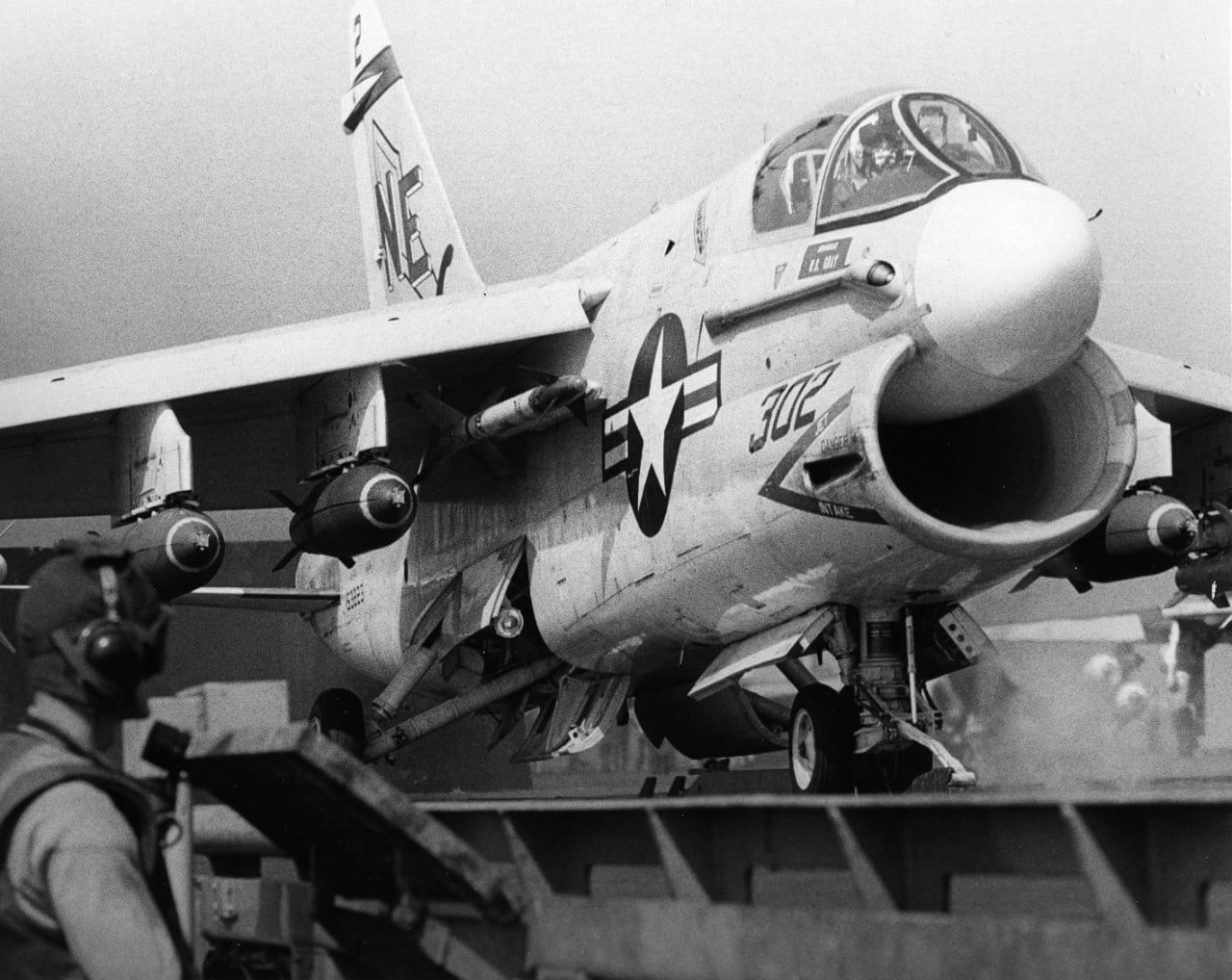
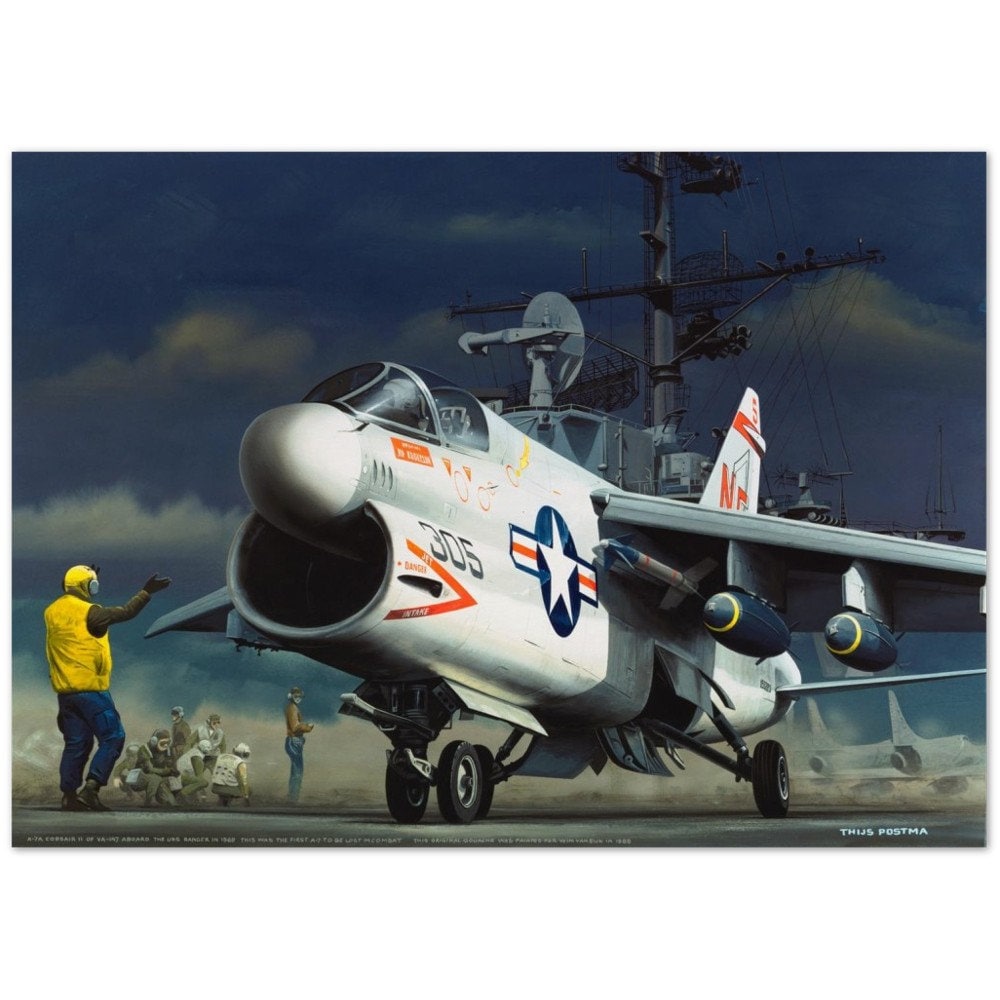
The LTV A-7 Corsair II is a portable subsonic attack aircraft. It is a derivative of the original fighter, the Vought F-8 Crusader; Compared to the Crusader, it has a shorter, wider tail and a longer wing, but does not have the Crusader's changing features. The A-7's wingspan was not much larger but had reduced clearance, with six pylons carrying 15,000 lb (6,800 kg) of ammunition or other ammunition. .
According to Gunston and Gilchirst, although there are similarities and common heritage between the two aircraft, they do not share common features.
However, conventional external ailerons (instead of the built-in ailerons in the F-8 that doubled when the flaps were installed) were used with large inboard wings; A wing package consists of flaps and ailerons. The leading edge of the wing is solid and toothless.
A large refrigerator is installed under the plane. All three landing gear were returned to the sail; He is known for his twin-wheel powered nose planes and catapult-assisted aircraft.
An A 7d Corsair Ii Aircraft Takes Part In A Ground Attack Mission During Amalgam '87, A Joint U.s./canadian Air Defense Exercise. The Corsair Is Armed With An Aim 9 Sidewinder Missile
To achieve the desired range, early versions of the A-7 were powered by a Pratt & Whitney TF30-P-6 turbofan engine producing 11,350 lbf (50.5 kN) thrust.
At the same time, General Dynamics used several other fighter jets of the era, including the F-111 Aardvark and the Grumman F-14 Tomcats. The TF30-P-6 does not require ignition for its subsonic role.
Later versions of the A-7 used different engines; According to Gunston and Gilchrist, this was due to the difficulty of doing so in meeting both military and civilian requirements.
These new powerplants include the powerful Pratt & Whitney TF30-8 and the Allison TF41-A-2, a licensed version of the Rolls-Royce Spey engine. The TF41 fixed the problems that had plagued earlier A-7 operations, such as reduced weight and low throw.
Ltv A 7d Corsair Ii > National Museum Of The United States Air Force™ > Display
The Air Force began using the A-7D with internal variants and gas turbine propulsion. The Navy A-7E used air turbine starting with an external air supply.
Air is fed through a duct through a simple nose hole similar to the F-8, despite the difficulty of the pilots.
Two balls are placed below
2022 a7, a7 aircraft registration, 802x a7, a7 aircraft images, 1746 a7, mindray a7, navy a7 aircraft, 1756 a7, a7 msrp, a7 attack aircraft, a7 envelope, a7 price